

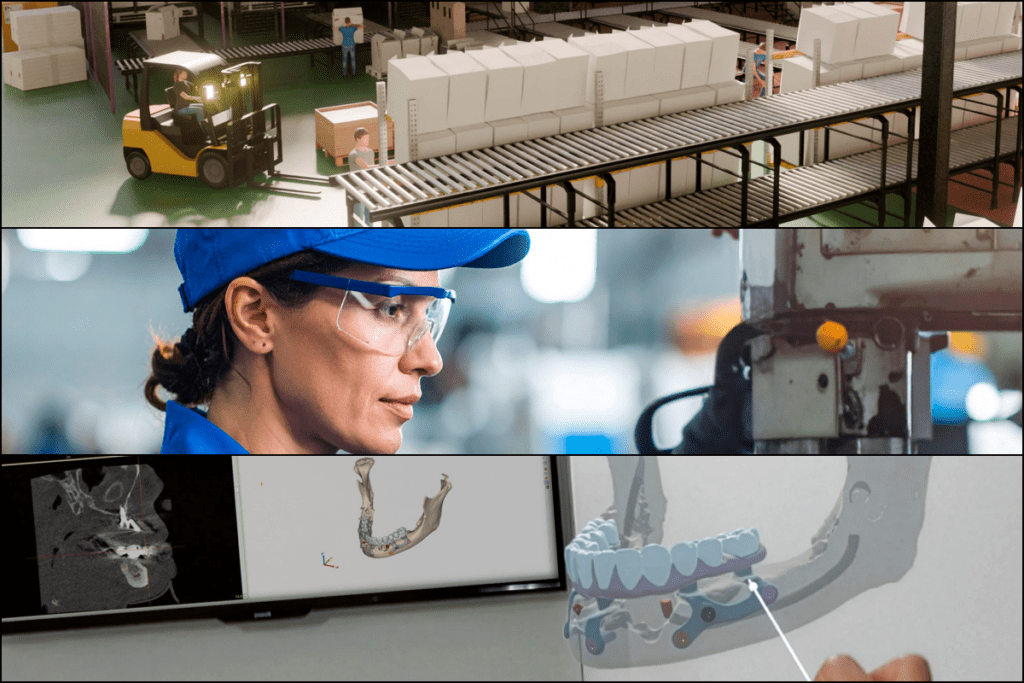
El Institute of Biomechanics (IBV) It develops the ERGOTWIN project, a project to simulate, analyze and optimize the design of work environments in an interactive way, incorporating the worker and the other agents involved in the design process.
Furthermore, the Valencian Technology Centre has developed solutions, through the ERGO_MAQUINAS project, to help machine design and manufacturing companies comply with the ergonomic requirements established in the new European Regulation (EU) 2023/1230, which will come into force in January of 2027.
Similarly, IBV is launching the XR-SURGICAL project, in response to the need by specialists for technological tools that help improve surgical precision, optimize preoperative planning and facilitate specialized training without risk.
Platform for designing and evaluating more ergonomic and efficient work environments
Adapting work environments to the characteristics of workers is key to maximizing productivity and reducing injuries and errors. Considering aspects such as anthropometric, physiological, and biomechanical characteristics, while taking into account the variability of the workforce occupying these positions, are fundamental elements for designing more ergonomic and, consequently, more efficient and productive work environments.
In addition to placing the worker at the center of the design process, it is essential to ensure the coordinated involvement and participation of the other agents involved, such as occupational risk prevention professionals, industrial design specialists, or HR managers.
In this context, el Institute of Biomechanics (IBV) is developing the project ERGOTWIN, whose general objective is to advance knowledge for the development and implementation of a digital twin that allows simulating, analyzing in real time and optimizing the design of work environments in an interactive way, incorporating the worker and other agents into the process, through a web tool that facilitates collaborative design.
ERGOTWIN's research concluded at the end of March and is in its final development phase.
In the words of Mercedes Sanchis, director of innovation in Occupational Health and Wellbeing at IBV, «The tool will allow the various stakeholders involved in the design process to access 3D virtual environments online. It will enable them to navigate the digitized work environment, view it from different perspectives, and simulate typical job tasks performed with avatars representing diverse population profiles. Furthermore, it will include ergonomics and human factors functionalities within the interactive environments, allowing for the ergonomic evaluation of workstations and informing design decisions.
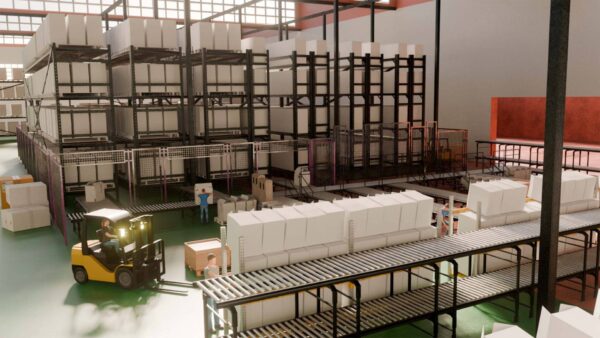
During the project it has been necessary to work on the design of digital human models with the appropriate characteristics and representative of the working population in the industrial field, as well as to advance in the modeling of the interactions of people with the work environment and the products present in it, developing ergonomic and human factors functionalities that allow extracting as much information as possible from the human-product system and provide useful information for decision-making during the different stages of the design process.
ERGOTWIN benefits from the active collaboration of established Valencian companies with extensive experience in the footwear sector, such as Panter, Paredes, PikoKaizen, and Pies Cuadrados Leather. This business collaboration has allowed research to be tailored to address real needs in the design of production and industrial environments within the footwear industry. Their valuable contribution to validating the project's results ensures the direct transfer of findings to the business and industrial community.
Finally, it should be noted that the ERGOTWIN project has the support of the Conselleria d'Innovació, Indústria, Comerç i Turisme de la Generalitat Valenciana, through IVACE+i, with funding from the European Union, through the FEDER Comunitat Valenciana 2021-2027 Program (IMDEEA/2025/43).
Ergonomics as an essential and mandatory aspect
The machinery sector is an essential part of the mechanical industry and one of the industrial pillars of the European economy. However, in many cases, machine design has not sufficiently considered the diverse physical characteristics of its users. This lack of adaptation can lead to awkward postures, excessive strain, and consequently, a higher incidence of musculoskeletal disorders associated with machinery use. Integrating ergonomic criteria from the design and manufacturing phases of machines, along with proper installation and maintenance, allows for the reduction of these risks and the improvement of working conditions.
With the aim of moving forward in this direction, the new Regulation (EU) 2023/1230 was enacted, which will enter into force in January 2027 (repealing the previous Directives 2006/42/EC and 73/361/EEC) and establishes the new mandatory regulatory framework for European companies in this sector. The new Regulation strengthens the consideration of ergonomic factors in the design and manufacture of machinery, increasing the requirements for European manufacturers.
In this context, the Institute of Biomechanics (IBV) has launched the project ERGO_MACHINES, whose objective is to generate knowledge and practical tools to help machine manufacturing companies comply with the new Regulation (EU) 2023/1230 and applicable ergonomics standards, also incorporating the gender perspective in accordance with the mandates of the European Union.
The new regulatory framework stipulates that, under the intended conditions of use, discomfort, fatigue, and physical and mental stress for the operator must be eliminated or reduced as much as possible. To this end, at least the following ergonomic principles must be taken into account: adapting to the morphological, strength, and endurance differences of the operators; avoiding the need to require demanding work postures or movements and manual forces that exceed the operator's capacity; providing sufficient space for the movement of the different parts of the operator's body; etc.
In the words of Mercedes Sanchis, Director of Innovation in Occupational Health and Wellbeing at IBV, “In this project, we have developed a methodology to help companies implement the ergonomic criteria that the new Regulation establishes as mandatory in the design and manufacture of machinery. The methodology includes criteria for inclusivity and gender-sensitive design, ensuring that machines can be used safely and efficiently by an increasingly diverse workforce in terms of gender, age, and geographic origin.
These investigations involved a preliminary analysis of the new regulations and applicable harmonized standards, identifying the key aspects and most relevant anthropometric measurements for ergonomic design. Based on these identified anthropometric measurements, key anthropometric information was extracted from the IBV database, representing over 12.000 women and men from across the European population, to address the ergonomic requirements set out in the Regulation for the design and manufacture of machinery.
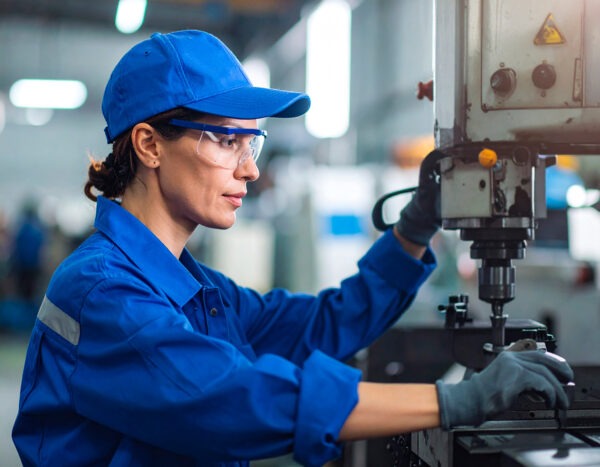
ERGO_MAQUINAS is specifically aimed at companies in the machinery manufacturing and engineering sectors, all of which have a high degree of mechanization and associated risk. These sectors are urgently demanding methodologies, anthropometric data, and practical solutions that will allow them to comply with European regulations before their entry into force in January 2027, with the corresponding impact on their operations.
For this reason, the initiative has the collaboration of companies such as Maf Roda Agrobotic, TICE. Engineering Solutions, Cebria, Henko Manufacturing, as well as the Business Confederation of the Valencian Community (CEV) and the Valencian Metalworking Business Federation (FEMEVAL).
This project allows companies in the Valencian Community and in Spain to anticipate the entry into force of regulatory changes and reinforce their commitment to the safety and well-being of workers.
Finally, the ERGO_ MAQUINAS project has the support of the Conselleria d'Innovació, Indústria, Comerç i Turisme de la Generalitat Valenciana, through IVACE+i, with funding from the European Union, through the FEDER Comunitat Valenciana 2021-2027 Program (IMDEEA/2025/45).
Extended Reality to improve surgical accuracy and optimize preoperative planning
The clinical field increasingly demands solutions that help improve surgical precision, optimize preoperative planning, and offer new, risk-free training methods. In this context, Extended Reality (XR) has established itself as a tool with enormous potential to transform surgical practice, given its ability to display additional digital information holographically, such as three-dimensional anatomical models based on the analysis of the patient's medical image, and to allow specialists to interact with them. By enabling the manipulation of anatomical structures and offering a level of detail superior to that achieved with two-dimensional images, Extended Reality promotes a deeper understanding and more precise preoperative analysis.
In this context, the Institute of Biomechanics (IBV) has launched the project XR-SURGICALWhose The main objective focuses on the generation and validation of Extended Reality scenarios intended to support specialists in surgical planning, delving into the development and precise positioning of digital elements for surgical guidance through the use of mixed reality.
The project is enabling, using medical imaging, the development and validation of highly immersive environments adapted to specific clinical cases. According to Carlos Atienza, Director of Innovation for the Health Area at IBV, “Work is underway to develop a Mixed Reality environment to support surgical planning for femur amputations requiring reoperation. To achieve this, medical images have been processed to obtain the patient's pathological anatomy, including the femur and structures relevant to the surgery, such as the femoral vasculature and adjacent musculature. Through the development and implementation of a tracking methodology specifically designed for this use case, holographic elements are projected onto what could be the patient's leg, providing information about its internal structure to assist the clinician in the surgical planning process.
Another example of the potential of XR-SURGICAL research has been in the field of maxillofacial surgery. With Mixed Reality, it is possible to visualize and overlay digital information obtained from medical imaging onto the patient's real-world environment. This includes the 3D reconstructed jaw, the path of the inferior alveolar nerve, surgical guides for milling, and the planned position of the implant and provisional dental prosthesis. The registration and tracking methodology developed by the IBV for this specific case ensures correct alignment between the digital models and the real-world environment. This precise overlay facilitates a more intuitive three-dimensional understanding of the anatomy and implant planning.
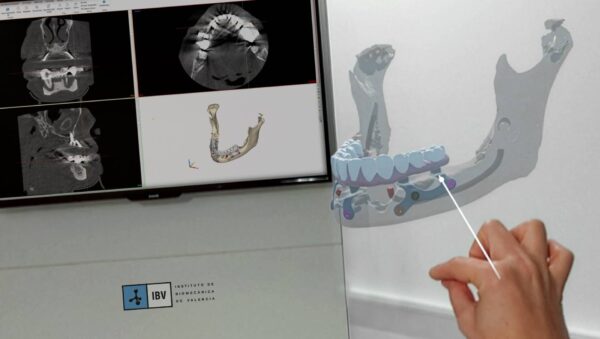
“The healthcare sector demands solutions that go beyond theoretical approaches. With XR-SURGICAL, we aim to design and validate Extended Reality scenarios applied to specific clinical cases, generating knowledge that is useful for both clinical professionals and companies in the healthcare sector.”Atienza added.
In this initiative, the IBV It features collaborations with leading companies in digital surgery, advanced manufacturing, medical devices, and immersive technologies. These include Avamed, specializing in digital surgery; Dyspsela, creator of customized XR solutions for training and industrial processes; InnoSurgery, focused on advanced manufacturing solutions and technological development for dentistry; Tequir, developer of implantable devices; and IT3D Group, a leader in 3D scanning and digitization solutions.
"Research projects like XR-SURGICAL represent a decisive step towards safer, more effective and sustainable healthcare models, in line with the digital transformation of healthcare.”Carlos Atienza concluded.
Finally, the XR-SURGICAL project has the support of the Conselleria d'Innovació, Indústria, Comerç i Turisme de la Generalitat Valenciana, through IVACE+i, with funding from the European Union, through the FEDER Comunitat Valenciana 2021-2027 Program (IMDEEA/2025/41).